In shortThe usual way to get to Salzburg from Vienna is the ÖBB Railjet: two services an hour, with the fastest Railjet Xpress taking about 2 hours 25 minutes via St. Pölten and Linz into Salzburg Hauptbahnhof. Driving covers about 332 km, mainly on the A1, and long-distance coaches run 29 times a day but set down at Salzburg South.
2 per hourRailjet trains from Vienna
about 2h 25mfastest Railjet Xpress
about 332 kmroad distance from Vienna
29 a daycoach departures from Vienna
How to get to Salzburg from Vienna, option by option
Take the train unless you have a specific reason not to. Two ÖBB Railjet services an hour run the corridor, the fastest of them, the Railjet Xpress, covers it in about 2 hours 25 minutes via St. Pölten and Linz and sets you down inside Salzburg Hauptbahnhof. Driving earns its place if Salzburg is one stop on a longer route into the mountains or the lakes. The coach earns its place if you want to be moving at 02:40 or coming home at 23:45.
About 332 km separate the two cities by road. The motorway runs well enough; the difficulty comes at the end, because the Old Town is closed to cars and you finish the trip on public transport from a Park & Ride site. Coaches do not reach the centre either, stopping on the southern edge of the city.
Do the arithmetic before the sightseeing. At about 2 hours 25 minutes each way, a same-day return from Vienna puts roughly five hours on trains, and that is before you add the walk to and from the stations at both ends. Book the earliest morning departure you can face.
| Option | Time | Frequency | You arrive at | Best for |
|---|
| Guided day trip from Vienna (the tour on this site) | 13 hours in all | fixed departures | Salzburg on foot with a guide, back at Albertinaplatz | one free day in Vienna |
|---|
| Drive yourself | about 332 km by road | when you like | Park & Ride Messezentrum or Alpenstraße | continuing into the mountains after |
|---|
| Long-distance coach | no single figure published | 29 trips a day, 02:40 to 23:45 | Salzburg South, Hellbrunner Landesstraße | very early starts and late returns |
|---|
| Railjet train, booked with the railway | from about 2h 25m on the Railjet Xpress | two an hour | Salzburg Hauptbahnhof | almost every visitor |
|---|
The Vienna to Salzburg train, in practice
Frequency is the real advantage here. Two Railjet services an hour means you are not tied to one departure, so a slow morning or a long lunch in the Old Town does not wreck the return. The 2 hours 25 minutes belongs to the Railjet Xpress, which makes fewer intermediate stops; other services on the same line take longer. Check which one your ticket is for, and confirm the time on the day you travel.
Luggage and comfort both favour the train. Your bag stays with you, you can work or sleep, and nobody spends two and a half hours concentrating on the A1. Flying in, take the direct Railjet from Vienna Airport, roughly hourly, from 2 hours 50 minutes, and skip the detour into the city.
One thing to look up for yourself: the earliest useful departure of the day. Reaching Salzburg before 10:00 rather than after it decides which of the paid sights you can still fit in before closing.
Arriving at Salzburg Hauptbahnhof and getting into the centre
Trains from Vienna terminate at Salzburg Hauptbahnhof, which has lockers, a lounge and a tourist information centre. Use the lockers if you are carrying more than a day bag: the fortress means either a funicular queue or a steep climb with steps, and a suitcase ruins both.
Trolleybuses handle the connection into the historic centre. Lines 1, 3, 5, 6 and 25 all leave from the station, and Rathaus and Ferdinand-Hanusch-Platz are the stops to aim for. From either one, Festungsgasse and the start of the fortress ascent are about five minutes on foot. Buy tickets from the machines, in the app or online before you board.
Walking in works if you have no bags and no timed museum slot; the protected centre runs along both banks of the Salzach and is compact once you reach it. With six usable hours and a fixed plan, take the trolleybus instead.
Driving in, and where coaches have to stop
Salzburg is reached by motorway on the A1 or the A10 from inside Austria, and cars and camper vans up to 3.5 tonnes need a toll sticker or a digital vignette before entering an Austrian motorway or expressway. Watch the validity rule when buying online: two-month and annual digital vignettes start only on the 18th day after purchase, while the one-day and ten-day versions can be set to take effect immediately. 2026 is the last year the adhesive sticker is sold.
Drivers from Vienna cannot finish the drive where they expect to, because no cars go into the Old Town and the restrictions have grown. The Neutor tunnel went out of use for motorised traffic on 14 September 2026 and stays that way for several months. Coming off the A1, the fortress operator's own directions point you to Park & Ride at Messezentrum; arriving on the A10, it is Alpenstraße at the Salzburg-Süd exit, with public transport for the last leg. Hotel guests, residents and the city-centre car parks stay reachable.
Coach parties have no discretion here. A coach from Vienna sets its passengers down at one of two terminals, North on Paris-Lodron-Straße or South on Erzabt-Klotz-Straße, and its operator has to reserve the arrival slot online beforehand. Scheduled long-distance coaches from Vienna run 29 times a day, the first at 02:40 and the last at 23:45, and they set down at Salzburg South on Hellbrunner Landesstraße. Allow for the ride into the centre at the start of the day and the ride back out at the end.
What a single day in Salzburg really covers
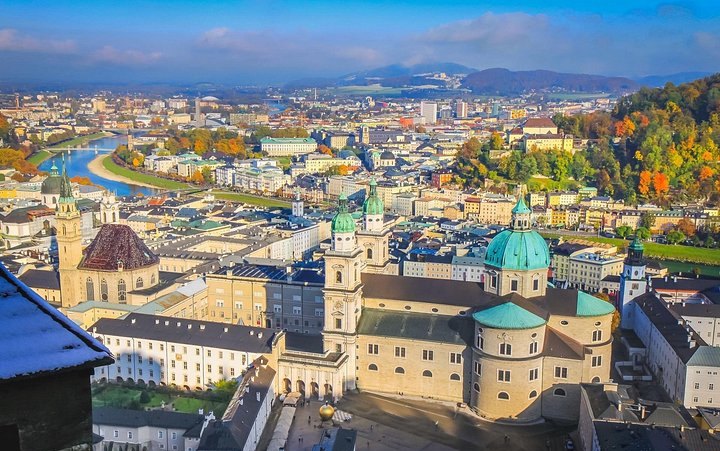
One day from Vienna is a city day. Mirabell and its garden, Getreidegasse 9 where Mozart was born on 27 January 1756, the cathedral quarter and Hohensalzburg all fit if you keep moving. Hallstatt, the Eisriesenwelt and the Bad Dürrnberg salt mine about 19 km out do not.
Whatever date your Railjet lands on, Hohensalzburg will be letting people in: public holidays included, it never closes for a day. Arrive in the January to April or October to December half of the year and you have from 9:30 until 17:00. Between May and September the grounds hold on from 8:30 to 20:00, while the State Rooms, the Magic Theatre and the other indoor museums run only 9:00 to 19:00. With a return train to catch, the ascent matters: cabins leave every 10 minutes, take 54 seconds and hold up to 55 passengers, against roughly 30 minutes on the steep stepped path beside the valley station, which no pram will manage.
Two opening quirks catch day-trippers out. Getreidegasse 9 takes visitors every day from 09:00, lets the last of them in 30 minutes before its 17:30 close, and wants about an hour for its three floors. Land on a Tuesday and the DomQuartier is the anchor you lose, since it stays shut that day; on the other six it opens 10:00 to 17:00, stretched to 18:00 every day in July and August, admission stops an hour before closing, and the Residenzgalerie is out of the circuit until autumn 2027. Between 19 November 2026 and 1 January 2027 the Christkindlmarkt fills Dom- and Residenzplatz, which adds minutes to every crossing of the cathedral quarter.
- Arrive before 10:00 or accept losing one paid stop
- January to April and October to December: the fortress day runs 9:30 until 17:00
- Travelling 9 to 13 November 2026: funicular maintenance shuts the museums and indoor areas as well
- Between 11 January and 14 March 2027 you reach the museums on foot, and they do stay open
- DomQuartier closed on Tuesdays
If you stay the night, use the spare half-day
If you turn the day trip into an overnight stay, the salt mines and Bavarian mountains half-day fills the second morning: 4 hours from the Mirabellplatz bus terminal, from €90 and rated 4.4 ★ (596 reviews), with 90 minutes underground at Berchtesgaden and the mine entrance included.
The guided day trip that takes the timing off your hands
If the connection times, the arrival point and the opening hours above sound like more admin than you want on a holiday, the Sound of Movies musical day trip from Vienna listed on this site handles the whole day as one booking: 13 hours, from €125, rated 3.8 ★ (89 reviews), in an air-conditioned coach or van with a professional guide or driver-guide and commentary in both directions.
The route takes in a walking tour in Salzburg with Mirabell Garden and the Pegasus Fountain, photo breaks at Mondsee and Wolfgangsee, and in summer the reconstructed gazebo in Hellbrunn Park. Departure is from Tourist Info Vienna at Albertina Platz 1, behind the State Opera House. Pickup from centrally located hotels in postcodes 1010 to 1090 is an option you choose when booking, and there is no pickup from apartments or hostels. The day ends at the Vienna State Opera on Albertinaplatz, with no hotel drop-off.
The coach day adds the two lake stops that no same-day train plan reaches, and it fixes your return time at the State Opera instead of the last Railjet.
Questions people ask
Is there a direct train from Vienna Airport to Salzburg?
Yes. A direct Railjet runs from Vienna Airport roughly once an hour and takes from 2 hours 50 minutes. That is about 25 minutes more than the fastest Railjet Xpress from the city, and it saves you transferring into Vienna first. Confirm the departure on the day, because not every service on the line is the quickest one.
Do I need a vignette if I drive from Vienna to Salzburg?
Yes. Cars and camper vans up to 3.5 tonnes must display a toll sticker or hold a digital vignette before entering an Austrian motorway or expressway. If you buy a digital one online, the one-day and ten-day versions can be set to immediate validity, while two-month and annual vignettes only become valid on the 18th day after purchase. From 2027 only the digital version will exist.
Where can I leave a bag if I come from Vienna for the day?
Salzburg Hauptbahnhof has lockers, plus a lounge and a tourist information centre, so drop your luggage on arrival and collect it before the return train. Use them if the fortress is on your list: the footpath beside the funicular valley station is steep and has steps.
Will Hohensalzburg be open on the day I arrive from Vienna?
Almost certainly yes: the operator keeps the fortress running on all 365 days, public holidays among them, so your travel date on its own will not stop you. The two exceptions are funicular maintenance periods: from 9 to 13 November 2026 the museums and indoor areas close with the funicular, leaving the footpath and the outdoor areas, and from 11 January to 14 March 2027 the museums stay open but you walk up.
Which day of the week should I not travel from Vienna?
Tuesday. The DomQuartier circuit does not open at all that day, and the Marble Hall at Mirabell is only reachable from 13:00 on Tuesdays and Fridays. Sunday is the next weakest choice, with the cathedral admitting visitors only from 13:00 on Sundays and holidays and Mirabell Palace closed. Monday, Wednesday and Thursday give you the widest set of open doors.
Read also