In shortSalzburg old town is the UNESCO-listed core between the Salzach and the fortress rock, on the list since 1996 and covering about 236 hectares with roughly 1,000 historic buildings. It is closed to cars. A single walk links Residenzplatz, the cathedral quarter, Getreidegasse 9, St. Peter's churchyard and Festungsgasse, five minutes from the Rathaus trolleybus stop.
1996UNESCO World Heritage listing
236 hectaresprotected historic centre
about 1,000historic buildings
5 minutesbus stop to Festungsgasse
Salzburg old town: what the UNESCO listing covers
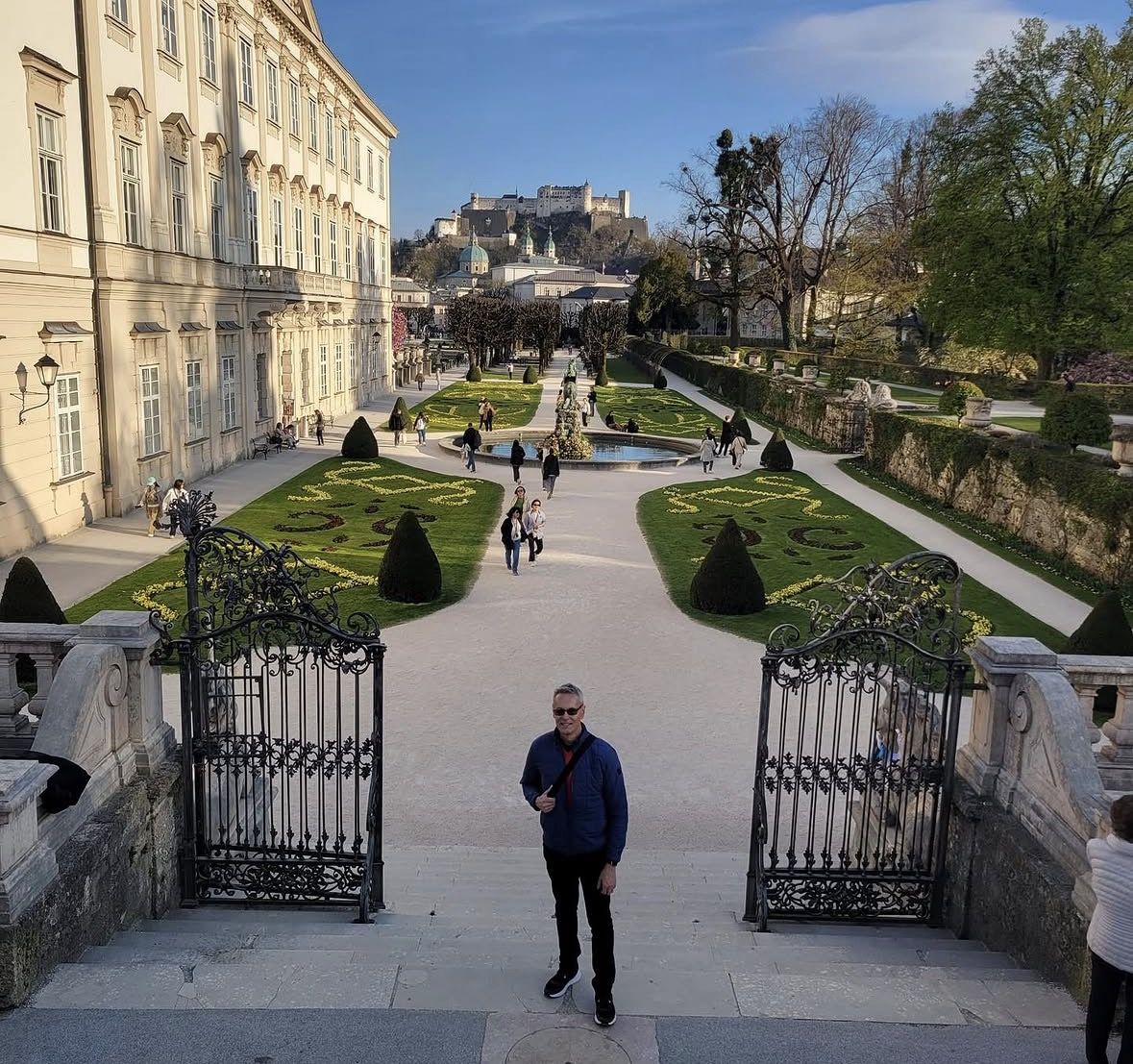
The historic centre has been a UNESCO World Heritage site since 1996 and takes in about 236 hectares with roughly 1,000 historic buildings along both banks of the Salzach. The landmarks named in that listing are Hohensalzburg Fortress, the cathedral, Getreidegasse, Nonnberg Abbey and Mirabell Palace, which tells you the shape of the area: a dense left-bank core squeezed between the river and the rock, plus the palace and garden across the water.
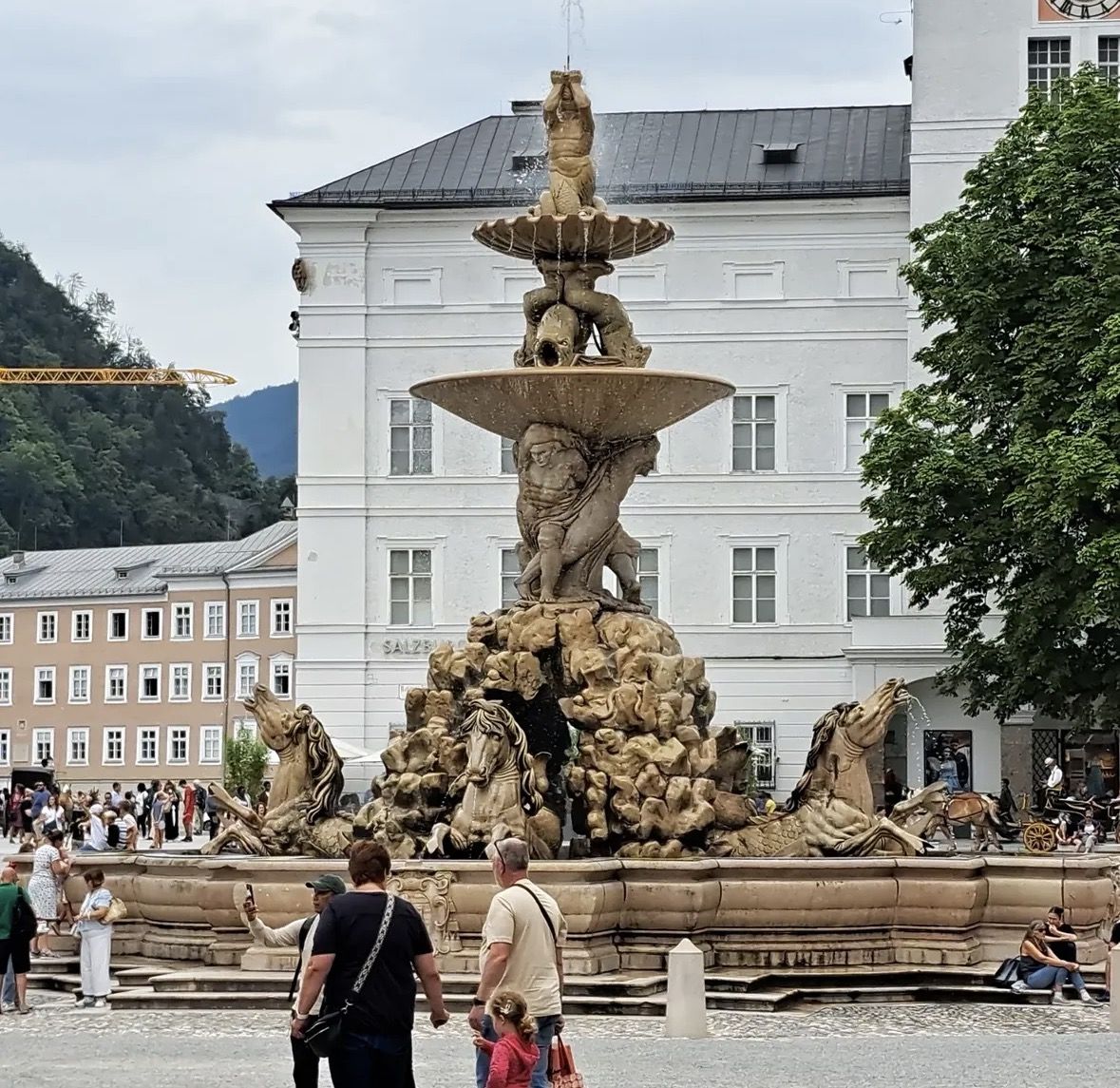
Most of what you came for sits inside a few hundred metres of that core. Residenzplatz is one of five grand squares laid out under Prince-Archbishop Wolf Dietrich von Raitenau, and it exists because 55 medieval buildings were cleared for it; the layout follows Mannerist plans by the Italian architect Vincenzo Scamozzi, and the fountain in the middle stands 15 metres high, commissioned by Guidobald Thun and attributed to the sculptor Tommaso di Garone.
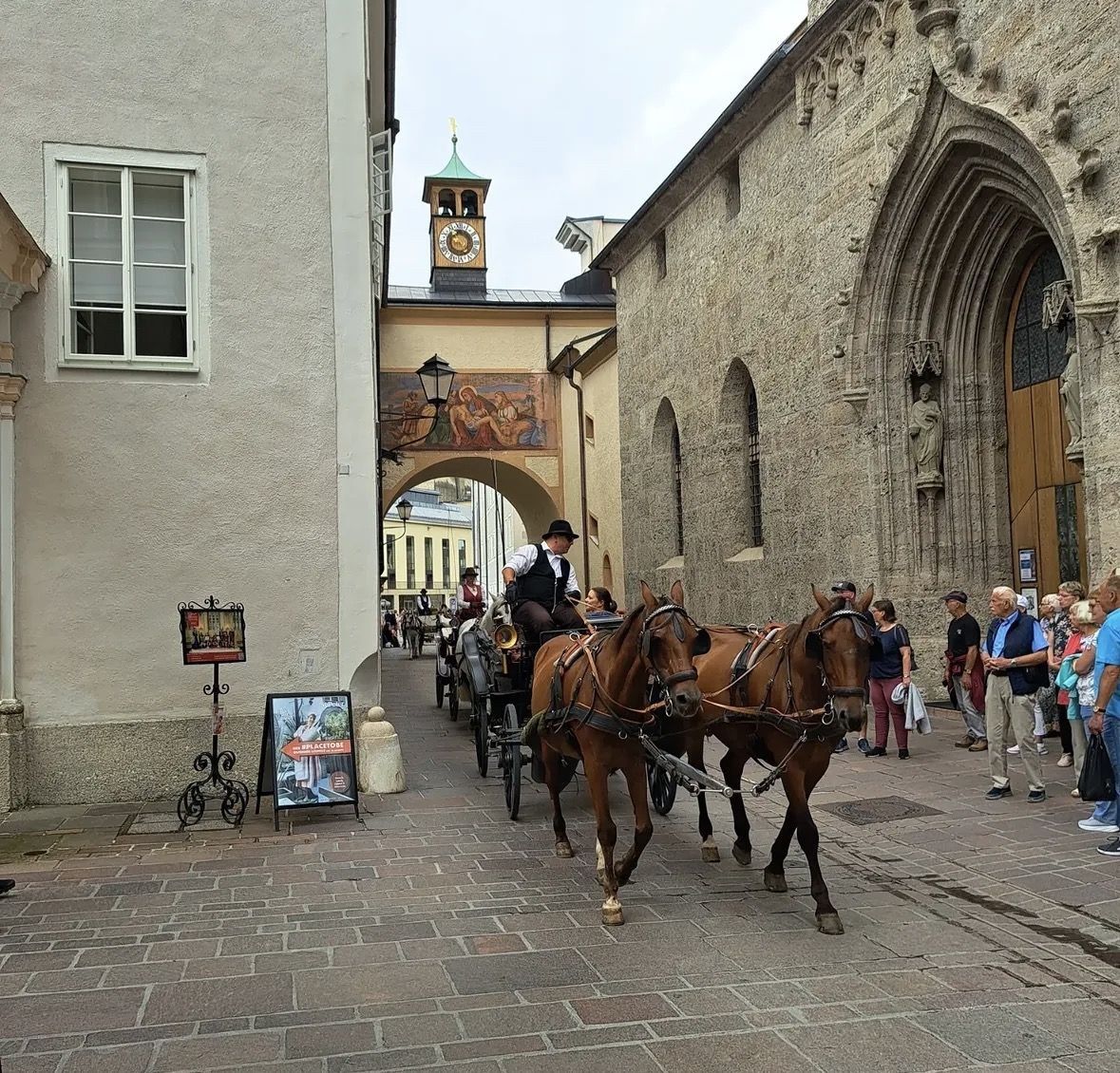
Treat the lanes and courtyards as the exhibit and the ticketed interiors as separate stops. The arcaded passages between the squares and the tall merchant houses on Getreidegasse are what the listing protects; the cathedral, the DomQuartier museum circuit, Mozart's Birthplace and the fortress each need their own time slot on top.
A Salzburg old town walking route, square by square
Start on Mozartplatz, where the city's tourist information office sits at number 5, and keep the river on your right as you move inland. The route then runs square to square without doubling back, and it ends at the foot of the fortress rock, which is the right way round: the climb is the one part of the day you do not want to do twice.
Time the cathedral quarter carefully. From Monday to Saturday the cathedral stops admitting sightseers between 12:00 and 12:30 for the midday organ music, the crypt opens an hour after the church at 10:00, and on Sundays and holidays nothing inside opens before 13:00. In January, February and November the church closes at 17:00 instead of 18:00, so a late-autumn walk needs the interior before mid-afternoon. The DomQuartier circuit does not open on Tuesdays and stops admitting visitors an hour before closing.
Between 19 November 2026 and 1 January 2027 the Christkindlmarkt stands on Dom- and Residenzplatz, trading into the evening every day. Crossing those two squares then takes noticeably longer, so put the fortress and the interiors in the morning and leave the stalls for after dark.
- Mozartplatz, with the tourist information office at Mozartplatz 5
- Residenzplatz, one of the five squares laid out under Wolf Dietrich von Raitenau, with the 15-metre fountain
- Domplatz and the cathedral, the early Baroque church Markus Sittikus had Santino Solari build, consecrated by Paris Lodron in 1628 and reconsecrated in 1959 after bomb damage to the dome and altar area in 1944
- the DomQuartier circuit, linking the Residenz State Rooms, the Cathedral Museum and the Museum of St. Peter
- St. Peter's churchyard, one of the oldest cemeteries in the world, with catacombs cut into the Mönchsberg rock
- Herbert-von-Karajan-Platz, with the horse pond of 1695 opposite the Festival Hall and the Felsenreitschule, a quarry turned riding school in 1693, behind it
- Getreidegasse, with Mozart's Birthplace at number 9
- Festungsgasse, for the funicular valley station and the footpath up to Hohensalzburg
| Stop | Opening window | Worth knowing |
|---|
| Salzburg Cathedral | Mon-Sat 9:00-18:00, Sun and holidays 13:00-18:00 in March to July, September, October and December | 9:00-17:00 and 13:00-17:00 in January, February and November; no viewing 12:00-12:30 Mon-Sat |
|---|
| Cathedral crypt | Mon-Sat 10:00-17:00, Sun and holidays 13:00-17:00 | the church is barrier-free, the crypt is not |
|---|
| DomQuartier | 10:00-17:00 daily except Tuesday, to 18:00 in July and August | last admission one hour before closing, closed 24 December, Residenzgalerie shut until autumn 2027 |
|---|
| Mozart's Birthplace, Getreidegasse 9 | daily 09:00-17:30 | last admission 30 minutes before closing; three floors take about an hour |
|---|
| Hohensalzburg Fortress | 9:30-17:00 January to April and October to December; grounds 8:30-20:00 with indoor museums 9:00-19:00 May to September | open every day of the year, public holidays included |
|---|
| FestungsBahn funicular | daily 9:00-17:00 per the operator, last ascent 17:00 and last descent 17:15 | maintenance stops 9 to 13 November 2026 and 11 January to 14 March 2027; check on the day |
|---|
Two hours for the squares and the Mozart story
This small-group walk, from €39 and rated 4.5 ★ (352 reviews), covers the Old Town highlights with a licensed guide and includes entry to the Mirabell Palace Gardens, so the ticketed interiors and the fortress climb stay yours to arrange around it.
★ 4.5/5 · 352 reviews
The lane where Mozart was born
Getreidegasse is the shopping lane that runs parallel to the river behind the squares, narrow, with tall houses and the painted guild signs hanging out over the pavement. The house at number 9 is where Mozart was born on 27 January 1756, and the museum inside it opens daily from 09:00 to 17:30, with the last visitors admitted half an hour before closing. The exhibition spreads over three floors and fills about an hour.
There is no barrier-free route inside that house. If stairs are a problem, the Mozart Residence is the wheelchair-accessible one of the two Mozart museums, and a combined ticket covers both.
Walk the lane early or late. It is the busiest strip in the protected centre at midday, and the arcaded passages that cut north from it towards the river are the part worth lingering in, which is hard when the lane itself is shoulder to shoulder.
How to reach the centre without a car
The Old Town is closed to cars, and driving near it has got harder: the Neutor tunnel has been shut to motorised traffic since 14 September 2026 for several months. The fortress operator's own directions send drivers to Park & Ride at Messezentrum, off the A1, or Alpenstraße, off the A10 at the Salzburg-Süd exit, and on by public transport from there.
Trolleybus lines 1, 3, 5, 6 and 25 run from Salzburg main station into the centre. Get off at Rathaus or Ferdinand-Hanusch-Platz, both about five minutes on foot from Festungsgasse, which puts you at the bottom of the route rather than the top. Coming from the airport, bus line 10 reaches the city centre in about 15 minutes and line 2 reaches the main station in about 23 minutes.
Coach parties have no discretion here. Tour coaches must use the North Bus Terminal on Paris-Lodron-Straße or the South Bus Terminal on Erzabt-Klotz-Straße, and arrival time slots have to be booked online in advance.
The climb to the fortress and the viewpoints above
Hohensalzburg is the end of the walk and the reason the route works in one direction. The FestungsBahn climbs to 536 m in 54 seconds, departs every 10 minutes and carries up to 55 passengers, so queues build when a coach empties. The footpath beside the valley station takes about 30 minutes, is steep, has steps and is, in the operator's own words, unsuitable for prams and not barrier-free. Walk up if you can and ride down if your legs have had enough.
Two maintenance windows change the plan. The funicular stops from 9 to 13 November 2026 and the fortress museums and indoor areas close with it, leaving the footpath, the courtyards and the view; if your visit falls in that week, go up in the morning and treat the fortress as a viewpoint. It is out again from 11 January to 14 March 2027, but the museums stay open and you simply add the climb.
The second high point above the lanes is the Mönchsberg, reached by the lift from the western edge of the Old Town, with the cliff-top terraces looking back across the roofs to the fortress. Nonnberg Abbey, founded in the 8th century and the oldest nunnery north of the Alps, sits on the far side of the fortress hill; the abbey itself is closed, but the church and the cemetery can be visited on the way down.
Dogs are allowed on the funicular muzzled and on a lead and in the fortress outdoor areas, but not in the museums, the Panorama Tour or the Princes' Rooms, even in a carrier. Drones are banned, and indoor photography is permitted without flash for private use only.
Walk it yourself or join a guided walk
The route above is self-paced and the distances are short, so the question is really whether you want the facades explained. Dates, patrons and the reason a square has the shape it has do not announce themselves: the cleared medieval houses behind Residenzplatz, the quarry that became the Felsenreitschule in 1693, the catacombs in the rock behind St. Peter's. A two-hour small-group walk with a licensed guide covers that ground and the Mozart story, and it includes entry to the Mirabell Palace Gardens across the river, which saves you planning that leg separately.
Interiors stay on your own schedule either way. Use the attraction pages on this site for the cathedral, the DomQuartier, Mozart's Birthplace and the fortress, and keep the guided walk for the streets between them.
Two other walks in the protected centre are worth knowing about. The Salzburg Festival runs its own 50-minute tour of the Grosses Festspielhaus, the Felsenreitschule and the Haus für Mozart, sold online only, capped at 20 people and run in German and English, with backstage areas excluded and no barrier-free route. The official tourist board also arranges guided tours for visitors with restricted mobility, for blind and visually impaired visitors, in easy language and with a sign-language interpreter, which is the route to take if the standard walk will not work for your group.
Questions people ask
Which weekday is best for the Old Town interiors?
Monday, Wednesday or Thursday. The DomQuartier circuit is closed on Tuesdays, and on Sundays and holidays the cathedral admits visitors only from 13:00 while Mirabell Palace is closed altogether. On a midweek day you can take the cathedral from 9:00, the crypt from 10:00 and the DomQuartier from 10:00 in one morning.
How accessible is the Old Town for wheelchairs and prams?
The squares and lanes are flat, and the cathedral is barrier-free apart from the crypt, with an induction hearing loop installed. Mozart's Birthplace at Getreidegasse 9 is not barrier-free, while the Mozart Residence is wheelchair accessible. The footpath up to the fortress is steep, has steps and is neither barrier-free nor suitable for prams, so use the funicular for the ascent; the Festival district tour is also not barrier-free.
Is Mirabell Palace and its garden part of an Old Town visit?
Mirabell is named in the World Heritage listing but stands on the opposite bank, so it is a separate leg of the walk. The garden opens daily from about 06:00 until dusk and the palace staircases and Marble Hall from about 08:00 Monday to Saturday, with the palace closed on Sundays and holidays. In the winter months the Hedge Theatre and Dwarf Garden are shut, and the Orangerie is closed for a redesign until December 2026.
What are the Christmas market hours on the Old Town squares?
The Christkindlmarkt occupies Dom- and Residenzplatz from 19 November 2026 to 1 January 2027. It trades 10:00-20:30 Monday to Thursday, 10:00-21:00 on Friday, 09:00-21:00 on Saturday and 09:00-20:30 on Sundays and holidays. On 24 December it runs only 09:00-15:00, and on 25 and 26 December 11:00-18:00.
Can I get to Hallstatt and still keep an evening in the Old Town?
Yes, with an early start. The Hallstatt trips on this site run 8 to 10 hours, and the 8-hour small-group day ends centrally near Mozart's Residence by the Mirabell Gardens, which leaves the squares and the lanes for the evening. What is open in Hallstatt itself depends on off-season hours.
Read also