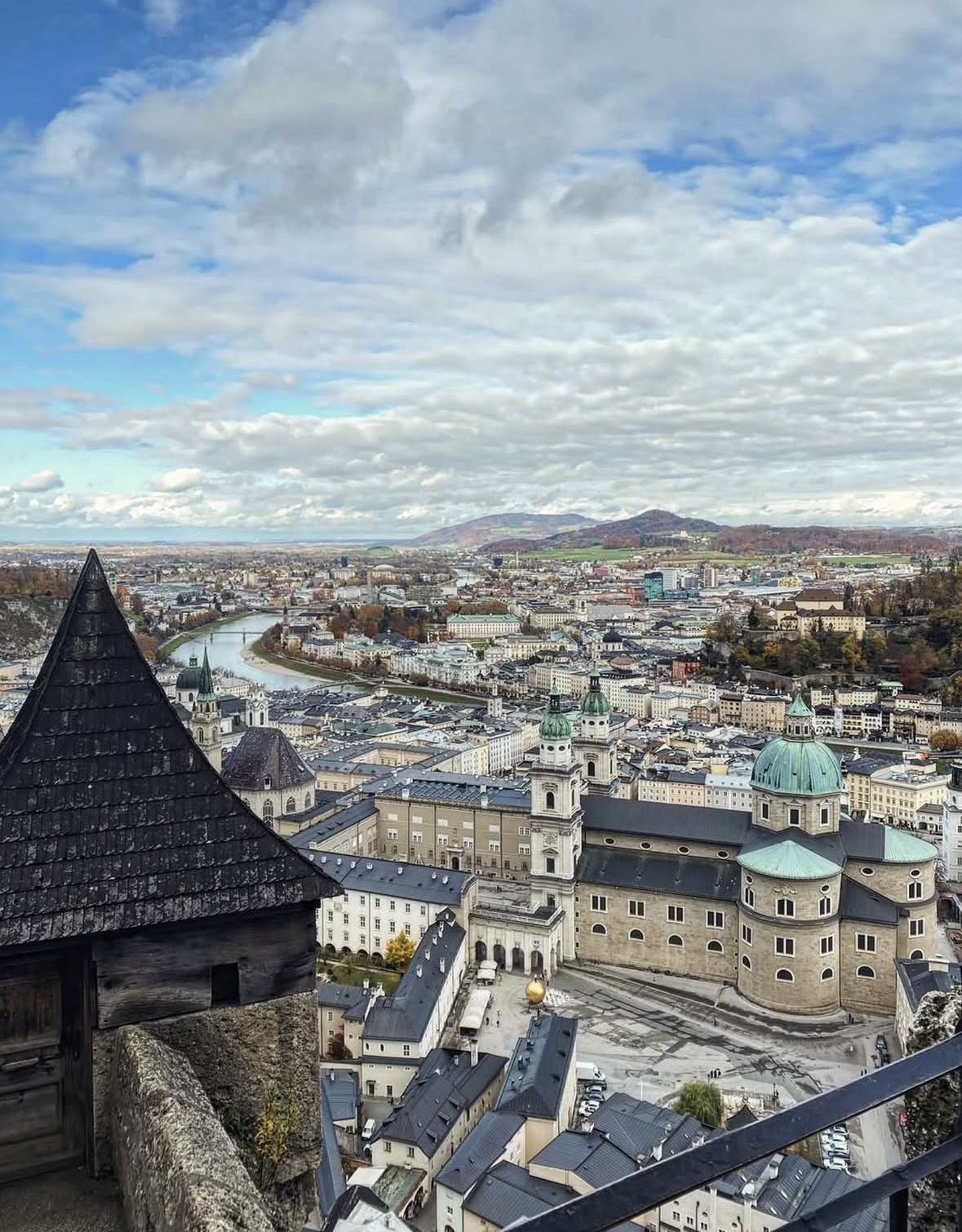
In shortSalzburg's sights fall into five clusters: the UNESCO Old Town with the cathedral and DomQuartier, Hohensalzburg Fortress at 32,000 square metres above it, the Mirabell and Hellbrunn gardens, the Mozart and Sound of Music sites, and trips out to Hallstatt, Bad Dürrnberg and Werfen. The fortress opens every day of the year; the fountains, boats and ice cave are seasonal.
32,000 m²fortress above the Old Town
236 hectaresprotected historic centre
8film locations in the city
from €392-hour Old Town walk
The Old Town and the cathedral quarter
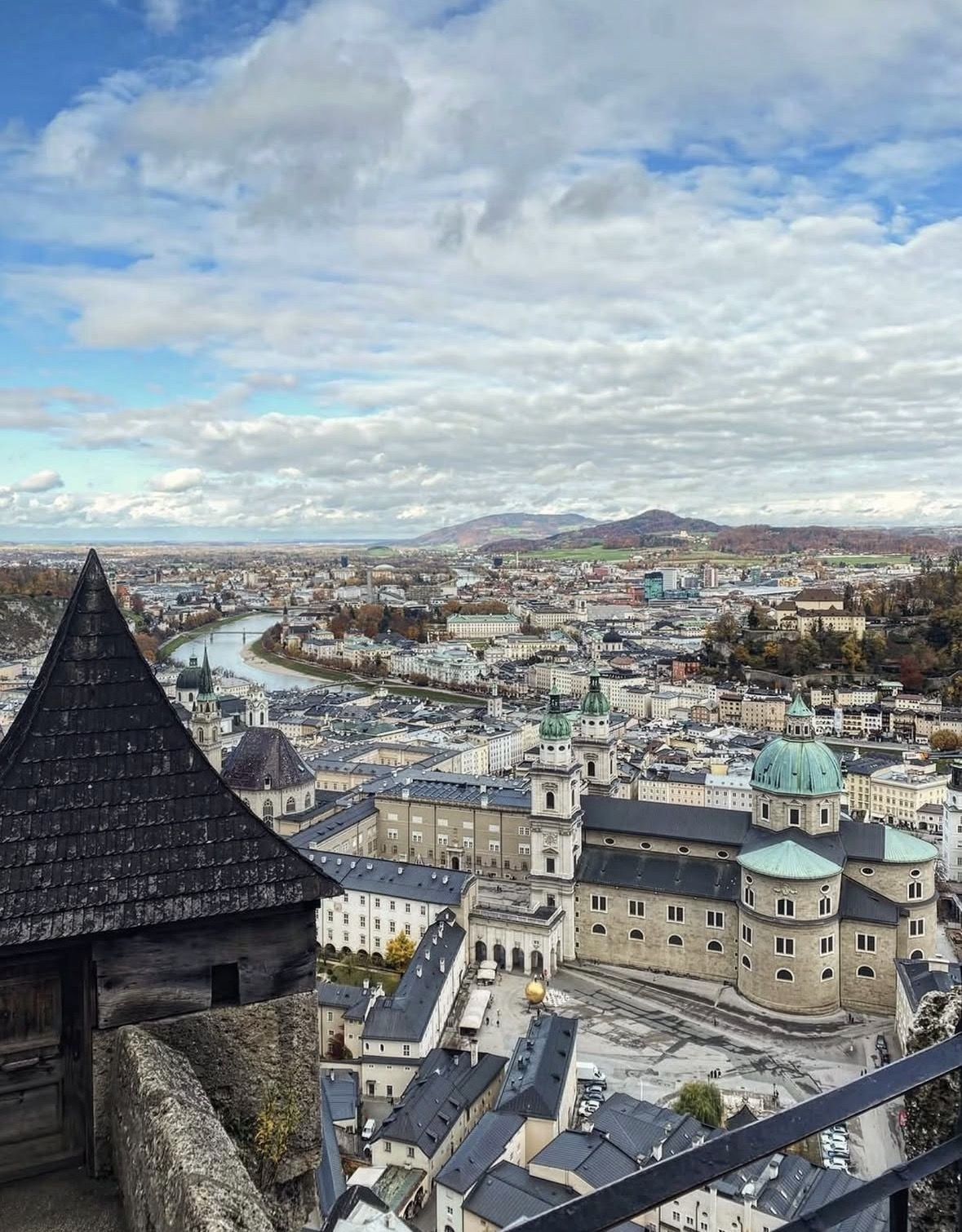
Everything in this first cluster sits inside a protected centre of about 236 hectares, with roughly 1,000 historic buildings spread along both banks of the Salzach and UNESCO status since 1996. Between March and July, and again in September, October and December, the cathedral admits visitors from 9:00 Monday to Saturday and from 13:00 on Sundays and holidays, with the doors closing at 18:00; in January, February and November the same pattern ends at 17:00. Viewing stops during services and during the midday organ music played 12:00 to 12:30 Monday to Saturday, so aim for mid-morning or the last hour of the afternoon. The crypt keeps shorter windows, 10:00 to 17:00 Monday to Saturday and 13:00 to 17:00 on Sundays and holidays, and in July and August the whole building shifts around Jedermann rehearsals and performances.
Four institutions are strung together by the DomQuartier circuit: the Residenz State Rooms, the Residenzgalerie, the Cathedral Museum and St. Peter's Museum. The Residenzgalerie stays shut until autumn 2027, so the current route is shorter than the leaflets suggest. Entry runs daily except Tuesday from 10:00 to 17:00, stretches to 18:00 through July and August, stops one hour before closing and does not happen at all on 24 December.
Out on Residenzplatz, one of five grand squares laid out under Wolf Dietrich von Raitenau, 55 medieval buildings were cleared for Vincenzo Scamozzi's Mannerist plans, and the 15-metre fountain commissioned by Guidobald Thun and attributed to Tommaso di Garone stands in the middle of it. Getreidegasse 9, where Mozart was born on 27 January 1756, runs daily 09:00 to 17:30 with the last admission half an hour before the end, and the three floors of exhibition take roughly an hour. Wheels are the catch at this stop: the birthplace has no barrier-free route through it, so anyone who needs one should swap it for the Mozart Residence, which is wheelchair accessible. A short walk away, St. Peter's Cemetery and the catacombs cut into the Mönchsberg rock are among the oldest burial grounds in the world.
Old Town, Mozart and Mirabell in two hours
A small-group walk with a licensed guide that ties the cathedral quarter, the Mozart story and entry to the Mirabell Palace Gardens into one 2-hour loop, from €39 and rated 4.5 ★ (352 reviews).
★ 4.5/5 · 352 reviews
Hohensalzburg and the hills
Hohensalzburg is the one constant in the Salzburg calendar: 32,000 square metres of walls, courtyards and museums that have grown on the rock since the 11th century, called by its operator one of the largest castle complexes in Central Europe, and open every day of the year including public holidays. Hours split by season. Between January and April, and again from October to December, grounds and museums keep one shared window of 9:30 AM to 5:00 PM, so there is no early or late slot to aim at and the hour straight after opening is the quietest you will get. From May to September the grounds open 8:30 AM to 8:00 PM while the indoor museums, State Rooms and Magic Theatre run 9:00 AM to 7:00 PM, leaving half an hour in the morning and a full hour in the evening when the bastions and the view belong to almost nobody.
Two ways up, and the choice is about legs rather than money. The FestungsBahn funicular climbs to 536 m in 54 seconds, leaves every 10 minutes and takes up to 55 passengers, which settles the matter if you have a pram, small children or any mobility limit. The footpath starts beside the valley station and needs about 30 minutes; it is steep, has steps and the operator states plainly that it is neither barrier-free nor suitable for prams.
Dates to plan around: funicular maintenance from 9 to 13 November 2026 also closes the museums and indoor areas, leaving only the outdoor areas reached on foot, while the longer stoppage from 11 January to 14 March 2027 keeps the museums open and simply puts you on the path. Drones are banned, indoor photography is allowed without flash for private use, and the Romanesque chapel is closed through the winter.
Higher ground is a separate half-day. The Mönchsberg lift takes you from the Old Town onto the cliff-top walkways in minutes, and south of the city the Untersbergbahn climbs to 1,776 metres in about 8 minutes on a massif that tops out at 1,852 metres. On the Untersberg the Hochalm and the mountain-station restaurant are closed for annual maintenance from 2 November to 13 December 2026, so check the operating status on the day before you set off for lunch with a view.
Palaces and gardens
Mirabell was built in 1606 as Schloss Altenau for Salome Alt and the 15 children she had with Wolf Dietrich von Raitenau, and the garden took its present shape around 1690 for Johann Ernst Thun to plans by Johann Bernhard Fischer von Erlach. The copper Pegasus was forged in 1661 by Caspar Gras and only reached its current spot in 1913. Europe's oldest dwarf garden still has 17 of its original 28 figures carved from white Untersberg marble, but it closes for the winter along with the Hedge Theatre, and the Orangerie is under redesign until December 2026.
Inside the palace the public part is small, because the city administration uses most of the rooms. The staircases and the Marble Hall are what you come for: Monday, Wednesday and Thursday from 08:00 to 16:00, Tuesday and Friday 13:00 to 16:00, and never during events. The hall was the prince-archbishop's banqueting room, where Leopold Mozart performed with Wolfgang and Nannerl, and the Schlosskonzerte Mirabell chamber series still plays there, usually from 20:00. The palace itself opens Monday to Saturday from about 08:00 to 18:00 and closes on Sundays and holidays; the garden opens daily from about 06:00 until dusk, with partial winter closures. For visitors on wheels this is the easiest stop in the cluster, since the whole complex is barrier-free and induction loops serve both the Marble Hall and the Pegasus Room.
Hellbrunn is the seasonal half of this cluster. The palace and its Trick Fountains closed for the winter on 1 November 2026 and reopen on 25 March 2027; in season their hours lengthen as the months go on: 09:30 to 17:30 in late March and April, 09:30 to 18:30 in May, June and September, 09:30 to 19:00 in July and August. The gardens keep their own schedule, 06:30 to 21:00 daily right through the year, which is why the Sound of Music gazebo setting still works as a winter walk. Bus 25 towards Untersbergbahn takes roughly 25 minutes from the Rathaus stop and 30 minutes from the main station.
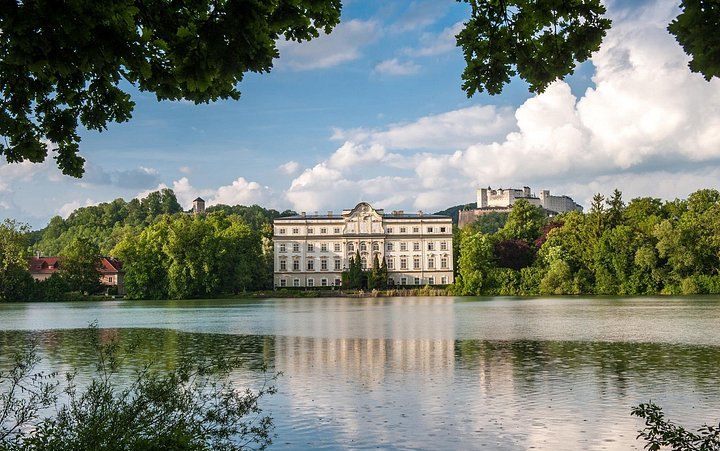
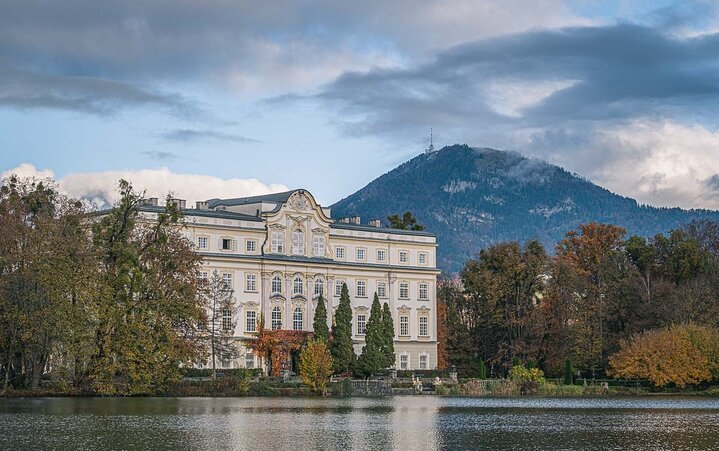
The third palace here works differently from the other two. Leopoldskron, Rococo and dating from 1731, operates today as a hotel under Salzburg Global Seminar. Rooms that are otherwise closed can be seen on booked guided visits, and the Meierhof Café & Bar is open to visitors daily from 10:00 to midnight.
Music and film: what to see in Salzburg on one theme
The festival district is the most concentrated stop for anyone interested in how the city sounds in summer. The Salzburg Festival's own 50-minute walk covers the Grosses Festspielhaus, the Felsenreitschule, which began as a quarry turned riding school in 1693, and the Haus für Mozart. Tickets are sold online only, groups are capped at 20, commentary runs in German and English, backstage areas are excluded and the route is not barrier-free. Scale matters for timing: the 2026 edition staged 171 performances on 45 days at 19 venues, the 2027 summer season runs 16 July to 29 August 2027 and the Whitsun Festival falls on 14 to 17 May 2027.
Evening options stay indoors all year. The Salzburg Marionette Theatre, whose puppetry practice UNESCO recognised as Intangible Cultural Heritage in 2016, lists The Magic Flute, The Sound of Music, The Nutcracker and a short Hansel and Gretel in its Winter 2026/2027 programme. The Mozart Dinner Concert pairs a three-course menu from historical recipes with opera melodies played by two singers and five instrumentalists of the Amadeus Consort in the candlelit Baroque Hall of Stiftskeller St. Peter.
Film locations are the cluster visitors underestimate, because they are spread out and several cannot be entered. Salzburg tourism lists eight shooting locations inside the city, and three of the best-known outside it sit well beyond walking range.
Frohnburg Palace, used for the Trapp villa exterior, belongs to the University Mozarteum and is closed to the public; Nonnberg Abbey, founded in the 8th century as the oldest nunnery north of the Alps, is closed as well, though its church and cemetery can be visited; Schloss Anif is privately owned with no visits at all. The gazebo was rebuilt near Hellbrunn's water features. That mix of reachable and locked is exactly why the 4-hour run on this site, The Original Sound of Music Tour in Salzburg, from €75 and rated 4.7 ★ (6850 reviews), covers the city and the lake district locations in one circuit from Mirabellplatz.
- In the city: Felsenreitschule, Nonnberg Abbey, Residenzplatz, Karajanplatz with the Pferdeschwemme horse pond of 1695, Mirabell Palace and Garden, Leopoldskron Palace, Hellbrunn Palace, St. Peter's Abbey
- Outside the city: Mondsee Basilica for the wedding scene, St. Gilgen on Lake Wolfgang in an opening aerial shot, the Untersberg in the opening and the escape
Trips out of the city, and what is open when
One half-day outside Salzburg changes the shape of a short visit more than a fourth museum inside it. The option across the border is the salt mines and Bavarian mountains half-day, 4 hours with a local guide in an air-conditioned bus, from €90 and rated 4.4 ★ (596 reviews), leaving from the bus terminal at Mirabellplatz, corner Hubert Sattler Gasse 1 in front of St. Andrew church; be there 15 minutes before departure. The mine entrance is included, and the time divides into 90 minutes inside the Berchtesgaden salt mine, on foot, by mini-train and by boat, and 50 minutes in Berchtesgaden itself. Plan it as a morning or an afternoon, with the rest of the day back in the city.
Underground, the Dürrnberg at Hallein is about 19 km out at Ramsaustraße 3, with a history long enough to explain the Baroque city: Celtic miners worked salt there from around 600 BCE in tunnels up to 280 m deep and 4.5 km long, mining resumed in the 12th century under the prince-archbishops, Hallein won its salt monopoly in 1530 and the mine took its first visitors in 1607. Winter hours are 9:00 to 15:00 from 2 November 2026 to 10 January 2027, and the posted closing time is when the last guided tour starts rather than when the doors shut. The mine then closes completely from 11 January to 5 February 2027.
Two mountain destinations are off the table for now. The Eisriesenwelt ice cave at Werfen opens daily only from early May to 1 November; its guided round covers about a kilometre of cave with 134 metres of climbing and roughly 1,400 steps, lasts about 75 minutes and needs around three hours in total, with air near 0 °C and no photography inside. Over on Mount Kehlstein, the Eagle's Nest at 1,834 m keeps a season of mid-May to the end of October, which takes it out of any plan made this side of spring. Below the cave, Hohenwerfen Castle is about 900 years old, falconers fly their birds several times a day on the Lindenwiese meadow, and its Romantic Advent Market opens on 28 and 29 November and on 5, 6 and 8 December 2026 from 13:00 to 19:00.
| Sight | When it is open | Watch out for |
|---|
| Hohensalzburg Fortress | Every day of the year; 9:30 AM to 5:00 PM Jan–Apr and Oct–Dec | Funicular maintenance 9–13 November 2026 closes the indoor areas too |
|---|
| DomQuartier | Daily except Tuesday, 10:00 to 17:00; to 18:00 in July and August | Residenzgalerie closed until autumn 2027; closed 24 December |
|---|
| Mozart's Birthplace | Daily 09:00 to 17:30 | Last admission 30 minutes before closing; not barrier-free |
|---|
| Hellbrunn Trick Fountains | 28 March to 1 November 2026, reopening 25 March 2027 | Gardens stay open 06:30 to 21:00 all year |
|---|
| Salzach boat trips | 26 March to 1 November 2026; 6 March to 1 November 2027 | No winter service |
|---|
| Salzwelten Salzburg, Bad Dürrnberg | 9:00 to 15:00 until 10 January 2027 | Closed 11 January to 5 February 2027 |
|---|
| Eisriesenwelt, Werfen | Daily, early May to 1 November | Around 0 °C inside; photography not permitted |
|---|
| Eagle's Nest, Mount Kehlstein | Mid-May to the end of October | At 1,834 m, so no winter visit |
|---|
| Christkindlmarkt, Dom- and Residenzplatz | 19 November 2026 to 1 January 2027 | 09:00 to 15:00 on 24 December, 11:00 to 18:00 on 25–26 December |
|---|
Guided or self-paced: planning things to do in Salzburg
Coverage per hour is the honest way to compare the two approaches. Inside the protected centre the clusters overlap, and a self-paced morning between opening windows works well once you know that the cathedral stops admitting visitors at midday for the organ, that the DomQuartier shuts on Tuesdays and that Getreidegasse 9 needs about an hour. A short guided walk adds the connective tissue between those stops and gets you oriented fast, which is why the walks listed on this site run 1.5 or 2 hours rather than a full day.
Outside the centre the arithmetic changes. Hallstatt is a full day by coach, 8 to 10 hours on the trips listed here, the film locations are scattered from Residenzplatz out to Mondsee, St. Gilgen and the Untersberg, and Bad Dürrnberg sits about 19 km from the city with its own seasonal timetable. On those routes a guided coach day is doing the transfers, the sequencing and the opening-hours arithmetic for you, and the themed tours on this site are built around exactly those three themes: film, salt and Mozart in the Old Town.
Accessibility is worth checking before you commit to any route. The fortress footpath has steps and is not barrier-free, Mozart's Birthplace is not barrier-free either, the festival district walk is not barrier-free, and the cathedral is accessible apart from the crypt and has an induction hearing loop. The city's state-certified guides, who offer around 80 different routes in 18 languages from Linzer Gasse 21/3, are also the people running walks for visitors with restricted mobility, for blind and visually impaired visitors, in easy language and with a sign-language interpreter.
Build the visit around two themes for one day and three for two days. The combinations below each have a workable geography.
- Baroque centre plus fortress: cathedral, DomQuartier, Getreidegasse and Hohensalzburg, all inside the protected 236 hectares and on foot
- Mozart and music: Getreidegasse 9, the Marble Hall at Mirabell, the festival district walk and an evening concert in the Old Town
- Film locations: eight in the city, plus Mondsee, St. Gilgen and the Untersberg outside it, which is a coach day rather than a walk
- Gardens and water: Mirabell year-round, Hellbrunn's fountains between 28 March and 1 November and its gardens in any season
- One half-day out: the Berchtesgaden salt mine and the Bavarian mountains in 4 hours, or the salt mine at Bad Dürrnberg about 19 km from the city
Questions people ask
Is Salzburg worth visiting if I only have one or two days?
Yes, because the distances are short. The protected centre covers about 236 hectares with roughly 1,000 historic buildings, and the cathedral, DomQuartier, Getreidegasse and the fortress funicular valley station all sit inside it. Hohensalzburg is open every day of the year, so the anchor sight is reliable whenever you arrive; one day realistically means the Old Town cluster plus the fortress, and the second day buys you either a film theme or a half-day outside the city.
Which weeks are the busiest in Salzburg?
The Salzburg Festival is the sharpest peak: the 2027 summer season runs 16 July to 29 August 2027, and the Whitsun Festival falls on 14 to 17 May 2027. School holidays stack on top, with Salzburg's own summer break from 10 July to 12 September 2027 and the Bavarian summer holidays from 2 August to 13 September 2027. In late autumn the Christkindlmarkt on Dom- and Residenzplatz fills the squares from 19 November 2026 to 1 January 2027.
What can I actually visit on 24 December?
Less than on a normal day, so plan it tightly. The Christmas market on Dom- and Residenzplatz opens only 09:00 to 15:00, then 11:00 to 18:00 on 25 and 26 December. The DomQuartier is closed on 24 December altogether. At the fortress, lunch is served at 13:00 with the concert at 15:00, and the Mozart Dinner Concert does not run on 24 December, resuming 17:00 to 21:30 on 25 and 26 December.
Can I take a dog or a pram up to Hohensalzburg?
Dogs may ride the funicular muzzled and on a lead, and the fortress outdoor areas are open to them. The museums, the Panorama Tour and the Princes' Rooms are closed to dogs, and a carrier makes no difference to that rule. For prams, the footpath beside the valley station is steep, has steps and the operator states it is unsuitable for prams and not barrier-free, so take the funicular, which runs every 10 minutes.
Where do the tours on this site start?
The Original Sound of Music Tour in Salzburg and the salt mines and Bavarian mountains half-day both leave from the bus terminal at Mirabellplatz, corner Hubert Sattler Gasse 1, in front of St. Andrew church. The 2-hour Old Town walk meets at the main entrance to Salzburg Congress, opposite The Cloud One Hotel Salzburg at Rainerstraße 3, by the flagpoles under the big tree between the Congress building and Kurgarten Park. Trolleybus lines 1, 3, 5, 6 and 25 connect the main station with the centre.
Read also